For Runners in Their 50s, 60s, and 70s
Run injury free into your 90s!
Don't Give Up the Sport You Love.
The Forever Runner Method is the proven framework that helped me go from two heart attacks to running ultramarathons in my 70s — injury-free.
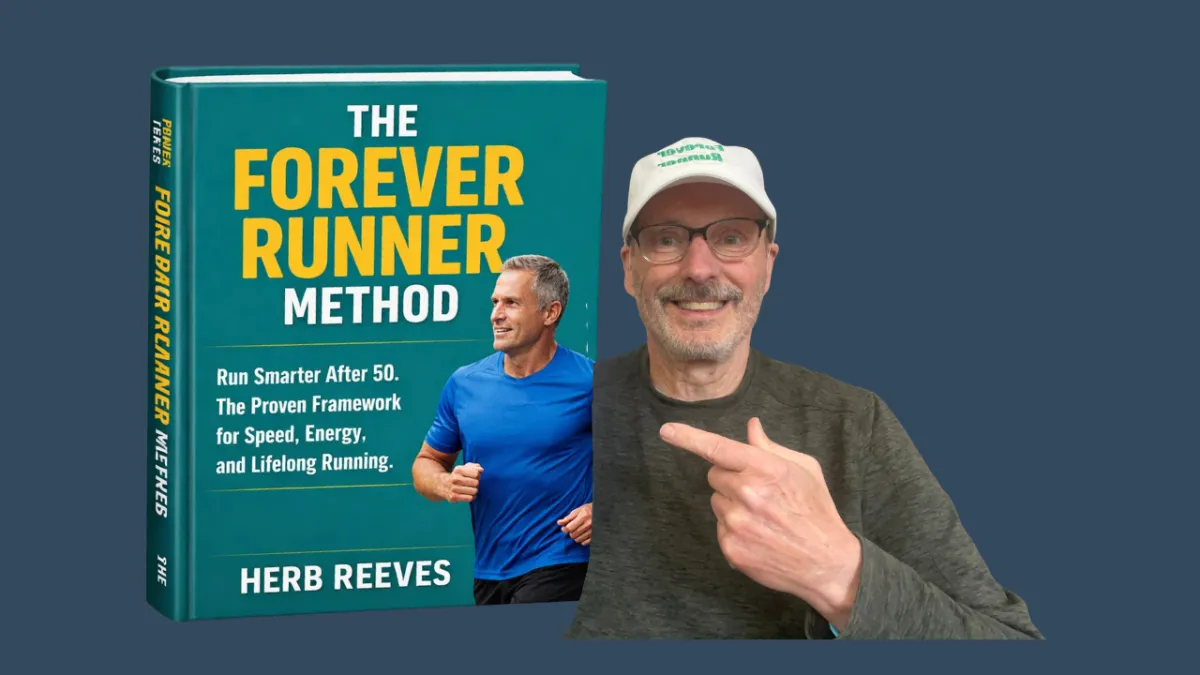
Instant Download - Read Your Copy Today!
I almost lost running for good. (Twice)
It was 5am on a Monday morning. I was at the CrossFit gym doing my warmup — just an easy spin on the bike. Then that warm flush came over me. Light-headed. Sweating. And then the chest pain.
I'd already had a heart attack at 50. This was my second one, at 62.
Here's what haunted me: I thought I was doing everything right. I'd run over 50 ultramarathons in the decade between those two events. I'd won age group awards. I had a sponsorship from Hammer Nutrition. I was fit. I was disciplined. And I still nearly lost everything — because I was training like a 35-year-old in a 62-year-old body.
"Training harder isn't the answer after 50. Training smarter is. It took two heart attacks to teach me that — so you don't have to learn it the hard way."
After the second heart attack, I went looking for real answers. I found Dr. Phil Maffetone's research, studied the longevity science, and rebuilt my entire approach to running from scratch.
What happened next surprised everyone, including me. My running didn't decline — it got better. At 71, I'm still running, still competing, still injury-free. I feel better doing it now than I did in my 50s, when I was grinding myself into the ground.
The Forever Runner Method is everything I had to learn the hard way, put into one simple, step-by-step framework — so you can skip the heart attacks and go straight to running pain-free for the rest of your life.
Sound familiar?
After 8 years coaching runners over 50, I saw the same five mistakes derail good runners over and over.
You're running too hard — every single time.
It feels good to push the pace, especially with friends. But it keeps you out of the aerobic zone where you actually build endurance and burn fat — and it's quietly setting you up for an overtraining injury.
You're running with the wrong posture — the "SIT run."
Years of sitting tighten your hip flexors and tip your posture forward at the hips instead of the ankles. The result: your foot lands ahead of you on every stride, braking your momentum and making every run feel like plodding.
You're eating like it's still 1995.
High-carb "runner's diets" worked fine at 30. Past 50, they're quietly driving inflammation, joint pain, and stubborn extra pounds that no amount of mileage will burn off.
You think running alone is enough.
It's not — especially now. Every year past 50, you lose muscle mass by default. Skip strength work, and running alone will not be enough to protect your joints or your longevity.
You're following advice built for someone half your age.
Most training plans, podcasts, and influencers are talking to 30-year-olds. We have different recovery needs, different hormones, and different risks. Following their playbook is how good runners end up on the injury list — or off it entirely.
The Forever Runner Method:
3 Keys, 9 Chapters
Each key builds on the last. Together, they're the exact system I used to go from two heart attacks to running stronger at 71 than I did at 51.
Key #1
BUILD — Build your aerobic capacity and run injury-free
The low heart rate training method that builds your aerobic engine, the recovery habits that keep you running pain-free, and a simple sprint strategy that makes you fast again — without the soreness.
Chapters: Jog · Rest · Sprint
Key #2
BURN — Switch your metabolism into a fat-burning machine
How to identify and remove the inflammatory foods quietly causing your joint pain, a simple 2-week reset that flips your metabolism from sugar-burning to fat-burning, and a flexible eating approach that ends the energy crashes for good.
Chapters: Heal · Reset · Flex · Bonus: Protein
Key #3
MOVE — Use it or lose it: activity beyond running
The daily mobility habits that keep your joints supple, and the simple strength routine — no gym required — that protects your muscle mass and keeps you running for decades, not just seasons.
Chapters: Activate · Mobilize · Lift
"Once you apply all three keys, you stop fighting your age — and start running better because of it."
What's Inside
The 180-minus-age heart rate formula that stops overtraining — and exactly how to train by it starting tomorrow.
The exact foods quietly driving your joint inflammation — and the simple swap that fixes it.
The 5 mistakes that end most older runners' careers — and how to avoid every one.
How to actually recover between runs, so you wake up ready instead of dragging.
Why running slower is the fastest path to running faster, pain-free.
A 10-second sprint protocol that rebuilds speed without next-day soreness.
A simple bodyweight strength routine that protects your joints — no gym membership needed.
A complete, step-by-step blueprint for running injury-free into your 80s and beyond.
Runners just like you are
already pain-free
My belly is melting down!
"Coach Herb helped me set my MAF heart rate to 133bpm although I am 57 years old. I have done 2 fasted runs so far and feeling no pain afterwards. Yes, my belly is melting down! I am looking forward to my next MAF test to see the improvement. Thanks again, Coach Herb!" -Rebecca M.
Delighted with your advice.
"I checked my heart rate regularly and, honestly, I could not believe it was not higher. My cadence was up and my heart rate — not far off Zone 2 — certainly felt reasonably comfortable. 3.5 miles over 50 mins. As I say, delighted with your advice. Had it not been for you, I would almost certainly have continued with the MAF stop-and-start runs for months, possibly a year!" - Andy M.
I am running without that broken feeling!
"You sure are a bringer of hope. I don't know if I will ever be one of your students that wins races but you have given me the ability to do what I set out to do 15 years ago — 'be one of those people running that looks like they are on skates just cruising.' This weekend was really cool as I went out and ran for fun and it was so easy!!! Right now I am running without that broken feeling I had, even in my prime. I think you saved me the fate of so many — the body's inability to run physically." Jama T.

ABOUT THE AUTHOR
Herb Reeves
I'm a 71-year-old running coach, ultramarathoner, and survivor of two heart attacks. I've run over 80 ultramarathons, won age group awards well into my 70s, and spent 8 years coaching older runners one-on-one.
I'm not a doctor. I'm not a professional athlete. I'm a mid-packer who learned — through some genuinely scary trial and error — how to keep running for life without destroying my body in the process.
The Forever Runner Method is everything I wish someone had handed me before my first heart attack. It's the simple, age-appropriate framework I built after watching the same five mistakes end good runners' careers, over and over, for nearly a decade.
I train in the Pacific Northwest with my Garmin, and I believe your best, most pain-free running years can still be ahead of you — if you train the right way for the body you have now, not the one you had at 30.
Get The Forever Runner Method Today
$7
One-time payment. Instant digital download.
The complete Forever Runner Method — all 9 chapters
The 3-Key BUILD, BURN, MOVE framework
Action steps and homework for every chapter
Bonus chapter: Why Protein Should Be Your Primary Focus
Read on any device — instant access after purchase
Try it risk-free for 30 days.
If the Forever Runner Method doesn't help you run with less pain and more energy, just let me know within 30 days and I'll refund every penny. No hard feelings — I just want this to actually work for you.
Common Questions
I'm not training for a race. Will this still help me?
Yes. Most of the runners I coach just want to keep running comfortably for life — not chase a podium. The BUILD, BURN, and MOVE framework works whether you're running for fun, fitness, or your next marathon.
What if I'm already dealing with an injury?
This book isn't a substitute for medical care if you're currently injured. But many of the habits inside — especially in the Mobilize and Rest chapters — are exactly what I recommend to runners working their way back from setbacks.
Do I need any special equipment?
No. You'll want a way to track your heart rate (a Garmin or similar device works great), but the strength and mobility routines use just your bodyweight — no gym required.
How is this different from other running advice out there?
Almost everything else is written for younger runners. This is built specifically around the physiology, recovery needs, and goals of runners in their 50s, 60s, and 70s — based on what actually worked for me and hundreds of my coaching clients.
What format is the book in?
It's delivered as an instant digital download you can read on any device — phone, tablet, computer, or e-reader.
Your Best Running Years Don't Have to Be Behind You.
For less than the cost of a coffee, get the exact framework that took me from two heart attacks to running ultramarathons, pain-free, at 71.
Instant download. 30-day money-back guarantee.
You've already put in the miles. You've already proven you have the discipline. All that's left is making sure the method matches the effort you're putting in.
I made every mistake in this book before I figured out how to fix them. I wrote it so you don't have to.
See you out there,
— Herb
"Run Smarter, Live Longer"

COMPANY
LEGAL
ADDRESS
©Copyright 2026. Forever Runner. All Rights Reserved.